Gino and Julius’s Friendship
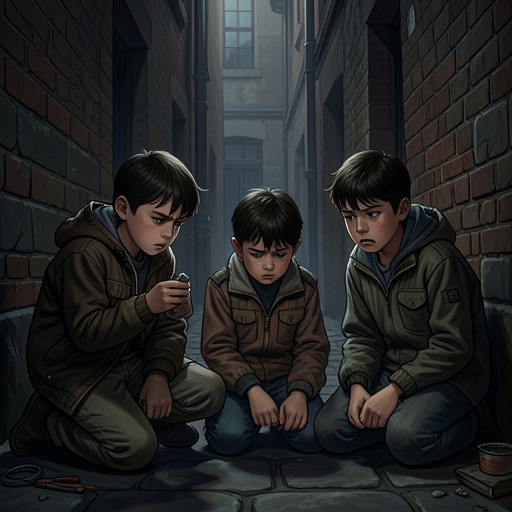
Sonne und BetonGino and Julius’s Friendship takes shape less through declarations than through the shelter they offer one another and the risks Julius is willing to share. Julius lets Gino stay at his home, gives him privacy when he arrives visibly injured, and backs his decision to join the computer theft despite Lukas’s objections. Their bond offers Gino a refuge from violence at home, but that refuge becomes entangled with a scheme that exposes both boys to further danger.
Refuge and Private Knowledge
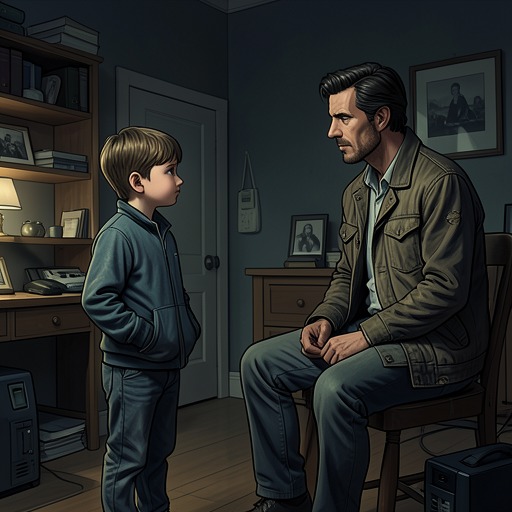
When Gino arrives at Julius’s apartment, his nose is swollen and his left eye is dark blue. He avoids Lukas’s gaze and brushes off questions about what happened. Lukas and Sanchez suspect that Gino’s father has beaten him, but Gino does not confirm it in front of them. Julius instead takes Gino into his room for a private conversation, asking the others to wait. He gives school as the reason, though Lukas doubts that explanation, and closes the door before they can join them.
The brief separation matters: Julius treats Gino’s situation as something to discuss with him directly, not as a story for the group. The scene does not reveal what they say behind the door, so it cannot establish that Julius persuades Gino or that Gino confides in him there. It does show Julius making room for a private exchange, while Gino accepts the invitation and goes into his room. Their closeness is conveyed through that small arrangement of access and trust, even as the substance of their talk remains withheld.
Julius’s home is no polished refuge. The apartment is cluttered, the floor sticky, and the air foul; when Adi tells the boys to take off their shoes, Sanchez and Lukas turn back toward the hallway. Gino, arriving separately, takes his shoes off. The contrast is pointed: Julius’s place offers Gino somewhere to stay, not comfort or security in any conventional sense. Its importance lies in the fact that Gino has spent a week living there, away from his father’s household, even if only temporarily.
Violence at Home and Julius’s Support
Julius later explains that Gino’s father will not let him go out. Gino had wanted to retrieve clothes from Julius’s place and return, but his father has imposed house arrest. Julius calls the father a bastard without lowering his voice. The account confirms that Gino’s stay with Julius was not just a brief visit: he had been living there for a week, and the attempt to collect clothes marks a forced return to the limits imposed at home.
Lukas’s concern about the father provokes Gino’s anger. Gino throws his lighter at a cupboard, shouts at Lukas to stop bringing up his father, and insists that he knows what will happen if the man finds out about the theft. He says the beatings happen regardless, pointing to his bruised face as evidence, and says he is tired of wearing bad clothes and having no money. His decision to join the scheme is therefore bound to material hardship as well as fear: he sees the stolen computers as a possible way to get money and some peace, while recognizing that the violence at home may continue.
Julius’s response is immediate and unqualified. He tells Lukas that he will help Gino, even if that means going ahead without Lukas. Gino does not answer him; he paces around Julius’s small room. That silence leaves the emotional effect of Julius’s pledge unstated, but the contrast is clear: Lukas has raised the danger, while Julius refuses to make his support conditional on Lukas’s approval. His loyalty does not resolve Gino’s situation, yet it gives Gino an ally at the moment he commits himself to the plan.
A Friendship Drawn into the Theft
The computer theft grows out of a group scheme, not a venture undertaken by Gino and Julius alone. Sanchez, Lukas, and the others are part of the planning, and Sanchez eventually produces a heavy bunch of keys that Julius recognizes as belonging to their school. Julius puts away his lock pick in response. The exchange shows the boys turning shared access into a practical route toward the computers, while placing their friendship within a larger circle of peer pressure and collective risk.
Gino’s willingness to take part is explicit in the argument over his father: he says he will join, and Julius backs him. The later nighttime entry, however, is narrated through Lukas, Julius, and Sanchez. Julius lays out how they will unlock the gate and reach the school door, and he reveals a silver blank-firing gun tucked into his waistband. The computers are eventually found in unopened cartons on high shelves; Julius points out a small ladder, while Lukas passes the machines down to the others. These details show the plan becoming a physical operation, but the scene does not establish that Gino is present for that entry. The distinction matters: the friendship supports Gino’s decision to participate, while the particular break-in described in detail places Julius alongside Lukas and Sanchez.
Loyalty and Its Limits
Julius’s care for Gino is concrete but not a rescue. He provides a place to stay, keeps the first conversation private, and offers to share the consequences of the theft. None of these acts can prevent Gino’s father from imposing house arrest or stop the abuse Gino describes. Nor does the evidence show what becomes of their friendship after the decision and the break-in. It presents loyalty as a powerful form of companionship, but one with limited reach: Julius can stand with Gino and help him act, yet the choices available to them remain shaped by violence, poverty, and the risks of the criminal plan.